A high odometer reading does not automatically call for a higher-capacity battery. You will be able to separate vehicle age, daily driving pattern and electrical demand, then check the exact Exide Mileage model against your car’s required battery technology, size and starting-current rating before buying.
Key takeaways
- Match voltage, capacity, CCA, dimensions, terminals and polarity.
- A high odometer reading alone does not justify changing battery type.
- Test charging voltage, starting performance and electrical drain before replacement.
- Ask the shop to confirm fitment and provide the battery warranty details.
Does a high odometer reading mean your car needs Exide Mileage?
No. A high odometer reading does not mean the car needs Exide Mileage. “High mileage” can describe accumulated kilometres or demanding use, but neither condition alone proves that this battery is suitable.
- An older car with many uninterrupted highway kilometres may give its alternator enough running time to replace the energy used during starting.
- A newer car making repeated short trips can remain undercharged because each start takes energy that a brief drive cannot restore.
- Stop-start traffic, long idling periods and high daily mileage around Hinjewadi increase starting and electrical demand, but they do not automatically justify a larger battery.
Battery choice follows the vehicle’s prescribed battery type, Ah capacity, CCA or starting-current requirement, case dimensions, terminal layout and hold-down fitting. Check the owner’s manual and existing battery label, not the odometer.
A correctly matched Exide Mileage model can suit an exide mileage battery for daily driving when the charging system keeps it adequately charged. Long drives usually provide more alternator runtime; short commutes can leave even a healthy battery partly charged.
If the car struggles after traffic use, test charging voltage under load, the belt, terminals and parasitic drain before changing battery size. Kilometre count alone is not a selection rule.
Which Exide Mileage car battery specifications must you match?
Choose the Exide Mileage model code, not a generic “high-mileage” battery. The range includes different Ah capacities and case sizes, so the car’s odometer cannot identify the replacement.
Compare the old battery label with the owner’s manual, then record the vehicle’s manufacture year, make, model and engine. The correct Exide Mileage car battery specifications still depend on that exact application, including common hatchbacks, sedans and compact SUVs driven around Hinjewadi.
| Specification | What to match | Why it matters |
|---|---|---|
| 12-volt system | 12 V | A wrong voltage can damage vehicle electronics |
| Capacity and starting current | Stated Ah and model-specific CCA or starting-current rating | Too little capacity or starting current can cause hard starts |
| Case and fitment | Length, width, height, weight and hold-down arrangement | A larger or unsecured case can move, vibrate or fail to fit |
| Connections | Terminal type, positive-terminal position and terminal clearance | Wrong polarity or cramped terminals can cause short circuits |
| Vehicle details | Model code, engine and manufacture year | Similar cars can use different batteries |
Before purchase, check these physical points against the car:
- Measure the tray and confirm the clamp or hold-down fits the replacement.
- Confirm the positive terminal is on the same side and cables reach without strain.
- Check that the terminals cannot touch the bonnet when it closes.
- Do not fit a battery with reverse polarity, even when its Ah rating matches.
Never use one universal Ah or CCA figure for every car. Ask the installer to verify the label, manual, tray and clamp before fitting.
Is Exide Mileage the right choice for daily driving and electrical loads?
Yes, an Exide Mileage battery for daily driving suits frequent starts and congested Hinjewadi traffic only when its specification and charging system match the car. Short commutes consume starting energy, while a long highway run gives the alternator more time to replace it; idling does not guarantee adequate charging.
- Record the original battery’s technology, Ah rating, CCA, dimensions, polarity and hold-down. Match the current manufacturer model data rather than choosing a larger battery by appearance.
- Count every load: dash camera parking mode, upgraded audio, GPS tracker, additional lamps and start-stop equipment. These can increase parked drain or charging demand, but they do not prove that a higher-capacity battery is correct.
- If the car sits unused, check for parasitic drain before blaming the battery. A battery can lose charge while parked even when its state of health remains good.
- Charge a discharged battery fully before conductance or load testing. State of charge describes how full it is; state of health describes its ability to deliver current and retain capacity.
| Option | Best decision criteria | Check before choosing |
|---|---|---|
| Exide Mileage | Routine use and budget | Current model data and original battery technology |
| Exide EPIQ | Higher electrical demand or longer expected service life | Charge acceptance, fitment and warranty |
| Exide EEZY | Vehicle age, simpler use and lower budget | Required Ah, CCA and physical compatibility |
Frequent short trips can defeat any model through repeated undercharging. Compare vehicle age, driving pattern, electrical demand, budget, expected service life and charge acceptance; there is no universal winner.
When should you reject Exide Mileage or investigate the car first?
Reject Exide Mileage until the car’s required battery technology and physical fit are confirmed. Cars with start-stop systems may require AGM or EFB batteries; compatibility with AGM or EFB applications is not established by the supplied Exide Mileage information. Check the original battery, owner’s manual and vehicle data before fitting.
Reject the battery if its case size, terminal position, terminal type or hold-down differs from the vehicle’s tray. A loose battery can suffer vibration damage, while incorrect polarity or bonnet-terminal contact can cause a short circuit. Battery-monitoring and energy-management systems may also require battery registration or a reset after replacement.
Use this diagnostic procedure when the battery repeatedly goes flat:
- Measure charging voltage under electrical load, rather than blaming the battery after one low-voltage reading.
- Inspect the battery terminals, cable ends, engine ground and body ground for looseness, corrosion or damage.
- Inspect the auxiliary belt for wear, cracking or slack that could prevent the alternator from charging correctly.
- Test for parasitic draw from dash cameras, GPS trackers, audio equipment, lamps or another aftermarket accessory while the car is parked.
- Assess the starter circuit for excessive current draw, then test the battery’s state of health after charging it fully.
Repeated discharge can also indicate an alternator or regulator fault. A new battery cannot repair that fault, and warranty terms do not erase damage caused by deep discharge, incorrect fitment, physical damage or an unresolved electrical problem.
What should you ask an Exide Mileage car battery shop in Hinjewadi to check?
Before accepting a replacement, ask the Exide Mileage car battery shop Hinjewadi to prove that the battery and vehicle match. If your search was “exide mileage high mileage cars hinjewadi car battery shop”, use this checklist rather than choosing by odometer reading.
| Check | Ask the installer to verify | Why it matters |
|---|---|---|
| Old battery | Condition, label, model code, Ah and CCA | A weak battery may be a charging fault, not a battery-size problem |
| Fitment | 12-volt system, polarity, tray length, width, height and hold-down | Reverse polarity or an unsecured case can cause serious damage |
| Installation | Terminal clearance, cable condition and battery security | A terminal touching the bonnet can short the circuit |
| Charging | Alternator output and charging voltage under load | A new battery will fail again if charging is inadequate |
| Electronics | Battery registration or a reset requirement | Start-stop and energy-management systems may need programming |
- Obtain an invoice showing the installation date, model code and written warranty terms.
- Ask how exclusions treat deep discharge, physical damage, incorrect fitment and unresolved electrical faults.
- Confirm that the shop will take back the old lead-acid battery for responsible recycling.
New Lucky Battery And Inverter in Hinjewadi and across Pune can be one service option, but its installation check—not the shop name—should establish fitment. Choose Exide Mileage only when measured vehicle requirements and the charging system support it.
Related product
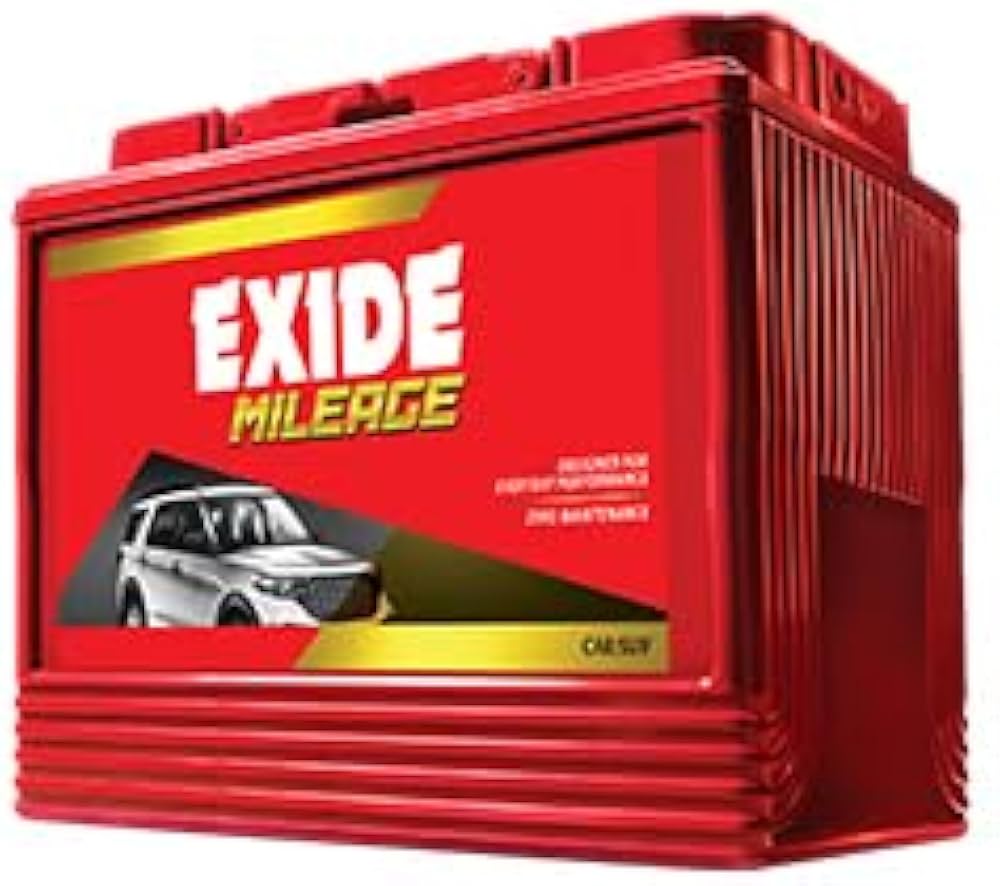 | AUTOMOTIVE BATTERIES Robust design - to take care of stringent application requirements Special side vented cover design - excellent spill-resistant characteristics... View product → |
Frequently asked questions
Does a high odometer reading mean your car needs Exide Mileage?
No. Odometer kilometres alone do not prove that Exide Mileage is suitable. Match the battery to the vehicle’s required specifications and assess its actual starting and charging performance.
Which Exide Mileage car battery specifications must you match?
Match the vehicle’s voltage, ampere-hour capacity, cold-cranking performance, case dimensions, terminal layout, terminal polarity and hold-down arrangement. Use the owner’s manual or the existing battery label as references.
Is Exide Mileage suitable for daily driving and electrical loads?
It is suitable only when its specifications match the car and its charging system supports the electrical demand. Account for accessories such as dashcams, amplified audio, auxiliary lights and frequent short trips.
When should you reject Exide Mileage or investigate the car first?
Investigate first when the car has slow cranking, repeated battery discharge, warning lights, corroded terminals, charging-voltage problems or unexplained electrical drain. Reject the battery when its size, polarity, capacity or starting rating does not match the vehicle.
What should you ask an Exide Mileage car battery shop in Hinjewadi to check?
Ask the technician to verify fitment, test the battery and alternator, inspect terminals and the hold-down, check for parasitic drain, record the battery details and explain the warranty process.
Keywords